
Broadway musicals are my obsession, as you can see from my giant ranking of best cast recordings of Broadway musicals! Therefore, it was with GREAT excitement that this weekend (November of 2024), I was finally able to see and review “Cabaret at the Kit Kat Club” starring Adam Lambert, and “The Great Gatsby” starring Jeremy Jordan and Eva Noblezada on Broadway in New York City!
How were these two Broadway musicals? Here are my honest thoughts…


“Cabaret at the Kit Kat Club,” NY: Review
First, some background: “Cabaret” is my all-time favorite play in terms of its songs, story arc, and passion. I’ve seen four different major productions of it, each extremely different, and know every lyric to every song. The play has gotten me through some very emotional times — and continues to do so.
This background is important because — “Cabaret at the Kit Kat Club” (this 2024 Broadway incarnation) is a VERY big departure from how this play is traditionally done. As a result, theatre-goers have had vastly differing reactions to whether they like these changes are not. Personally… these changes did NOT work for me. Let’s go over them individually.


1. The round theatre is structurally problematic.
When “Cabaret at the Kit Kat Club” transferred from London to New York City, the August Wilson Theatre on Broadway was completely renovated from a classic stage to a round stage with seating all around it in a circle. While the benefit of this is a more “immersive” experience with audience members getting closer to the action, there is a VERY big problem with this choice: Over half of the time, the actors have their backs to you!!! (Note: I was in seat Orchestra 5, Row H, Seat 5, which has a particularly acute version of this problem; avoid those seats.)
Now, watching the back of an actor’s head is frustrating enough, but in “Cabaret” in particular, there are key lines that need to be delivered with a quick turn of the head to directly face the audience — for example, “Tomorrow belongs [quick turn to the stage and shift in tone to a creepy whisper] TO ME.” Without the sudden eye contact, these lines lose much of their power.


2. Starting with a creepy and ravaged tone robs the arc.
In most productions of “Cabaret,” the first half of the play is staged to delight, seduce, and enrapture — like the lights of Times Square. The costumes are alluring, the tunes catchy, and the lighting and sets flashy. This seduction gives the tragic arc of the second half of the play its impact.
Unfortunately, in the version of “Cabaret” at the “Kit Kat Club,” the tone — from the first minute — is decayed, creepy, and off-putting. Extra lines are even added to dial up the “ick” factor. For some theatre-goers, this choice adds to the haunting nature of the play. For me, it upends the entire flow of the play; instead of going from high to low emotionally and ethically, it starts low and just gets lower.


3. Stripped-down costumes, sets, and percussion dial down drama.
For much of “Cabaret at the Kit Kat Club,” the actors are barefoot. Costumes are either scary and off-putting (ex: clown, skeleton, or insane baby doll costumes), or mundane (ex: tan suits and big underwear). The sets are minimal, and the orchestra seems to be missing some key pieces — especially percussion.
All of these “dialed-down” choices make for a more haunting production that gets under your skin because it feels more realistic — almost like normal everyday people versus larger-than-life actors — so some theatre-goers enjoy this directorial choice. For me, however, it robbed the play of its glamour and passionate heartbeat.
The prime example of this issue is evident in the rendition of the song “Mein Herr.” Traditionally, this song has a rousing, thumping beat underscored by the high-heeled boots of the dancers, and by chairs that they slam up and down on the floor. In contrast, this 2024 Broadway version has none of that — and thus in my opinion loses its pulse.


Positives of the Play
Despite my issues with “Cabaret at the Kit Kat Club,” I’m extremely glad I saw it! Part of the fun of theatre is getting to witness different versions of great art, and discussing what works and doesn’t for each person, individually. So, what DID work in this play?
Well, first and foremost, Adam Lambert as the Emcee is AMAZING. He’s one of the best singers in the world right now, and learning he was starring in “Cabaret” after Eddie Redmayne left is what spurred me to buy my tickets. (Unfortunately the other star, Auli’i Cravalho was out doing “Moana 2” promotion the day I saw the play, so I didn’t get to see her performance.)
Second, the story of “Cabaret” is absolutely pivotal for our world right now. Honestly, that may have been one reason why the more realistic staging of the play was so unsettling… but theatre that unsettles you is vitally important if it spurs new thinking and actions.

“The Great Gatsby” on Broadway: Review
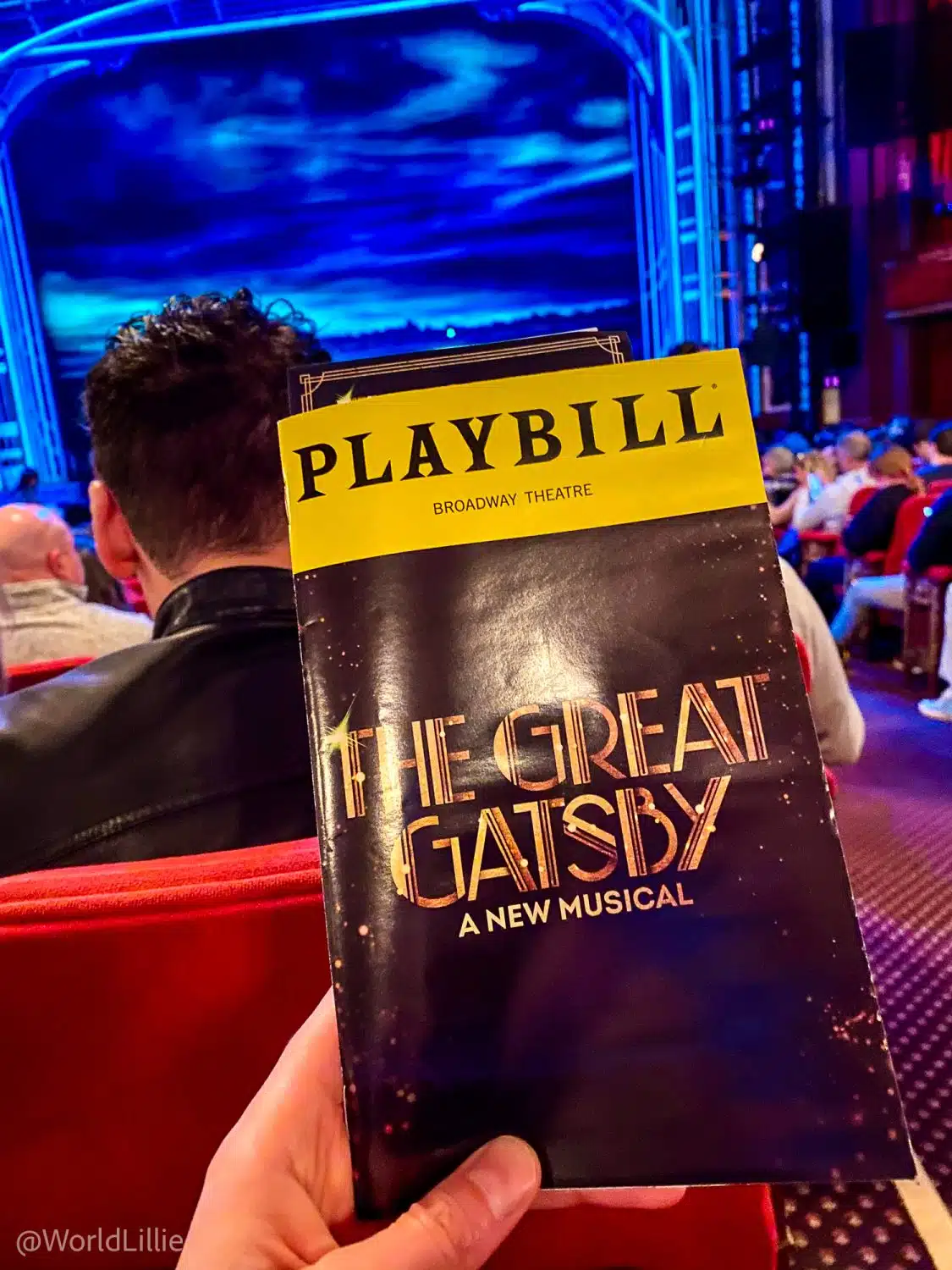
The day after I saw “Cabaret at the Kit Kat Club,” I was able to snag a well-priced ticket to see “The Great Gatsby” on Broadway, starring the absolutely incredible Jeremy Jordan and Eva Noblezada. What did I think of this play?
Well… I LOVED IT! But most critics and theatre-goers don’t. Let’s unpack this disconnect.


A. Glitz and glamour are front and center!
The biggest criticism of “The Great Gatsby” by professional reviewers is that it has taken the tragic Fitzgerald novel and made it “all glitz and no substance.” Listen — I’ve been an English teacher for twenty years, and I get what critics are saying here… but I don’t care.
At the end of the day, I go to and listen to Broadway musicals for a transporting, beautiful escape, and “Gatsby” truly provides that. It is one of the most visually gorgeous plays I’ve ever been to, with sparkles and sequins and gold dancing around a giant, sumptuous set that perfectly complements the action. The dancers, singers, and actors are all phenomenal, and you truly get your “Big Broadway” bang for your buck. However, some homework is needed…


B. The “Gatsby” songs need pre-listening.
A second criticism I’ve heard of the play is that the “songs are not memorable.” Yes, that’s how I felt the first time I listened to the cast recording several months ago when it came out… but the more I listened, the more I appreciated the tunes and lyrics.
In particular, the songs “For Her” (including its spectacularly melodramatic reprise) and “Go” take my breath away. As an English teacher, I also appreciate how the writers took actual lines from the book and crafted entire songs around them.


C. Jeremy Jordan is EPIC.
I waited until the last minute to get my “Gatsby” tickets so I could make sure Jeremy Jordan himself was acting for that matinee — and he was! (Tip: You can set up alerts on Understudies.org to check.) I have followed Jeremy Jordan since his “Newsies” and “Smash” days, and cannot recommend enough taking the opportunity to see him live in anything he’s in! In person, he exceeded my already sky-high expectations.
D. The themes are resonant.
Despite being VERY different plays, both “Cabaret” and “Gatsby” riff on two tragic and timely themes. First: Obsessively wanting and idolizing something that you can’t quite have, and that’s not only unattainable, but unhealthy. Second, making “not ideal” choices in order to survive.
For example, this version of “Gatsby” gives Daisy a whole song at the end of the play about how a woman’s choices at that time were not hers, and so she had to make a calculation to give up Gatsby in order to maintain the life of her and her daughter. This resonates with the “Cabaret” number, “What Would You Do?” and asks us if WE would really make dangerous choices if we were in these characters’ shoes — or just do what we need in order to survive.
In short, I think the assertions that “Gatsby” on Broadway is “fluffy and lacks substance” aren’t founded. There is certainly a lot to discuss and unpack in the play — and even more so if it leads you to re-read the great novel, as it did for me!


“Gatsby: An American Myth” at the ART in Cambridge, MA
Because the rights to the book “The Great Gatsby” just became public since it was published 100 years ago, the “Gatsby” currently on Broadway is not the only musical of the story that was created this year! At the American Repertory Theatre (ART) in Cambridge, MA, a rival play called “Gatsby: An American Myth” opened in early 2024 featuring the songs of Florence Welch, and starring the phenomenal Solea Pfeiffer (from Hadestown) as Myrtle.
How did the ART “Gatsby” compare to the Broadway version, given that I saw both? Well, the ART incarnation is WAY sadder, darker, and more complex, leaning heavily into the decay, corruption, and desperation of the story. The sets and costumes featured only a few colors (black, bronze, and silver), and the set consisted of tangled silver cars smashed together. Given what I’ve shared before about my escapist aims in watching theatre, you can probably guess that I liked the colorful Broadway version better — though I did get a lot out of the ART one, and found it interesting.
Solea (and thus the character of Myrtle) is the star of this version, with her heartbreaking story expanded upon extensively at the ART. The music was solid, but as there’s no cast recording out yet (perhaps because they’re reworking the play), I would need to listen more to give further analysis. Meanwhile, the character of Tom was so brutal in the ART version that it was painful, whereas the Broadway Tom makes more sense to the story in that his veneer of likability is thicker, making it more understandable why Daisy stays with him.
The ending of the ART version of “Gatsby” is a… surprise. There are big changes made to the story that are true to the book in spirit, but not the actual words — and they aaaaalmost work. I appreciated what the writers were trying to do, but ultimately it just didn’t come together in a resonant way for me.
This is all to say that I do NOT think “Gatsby: An American Myth” will transfer to Broadway without MAJOR revisions — if at all. Though there were wonderful parts to it and it left me with a lot to think about, it’s not a Broadway match yet.


“Cabaret” and “Gatsby” Broadway Review, in Sum
In closing for this 2024 “Cabaret” and “Gatsby” Broadway review, I want to reemphasize that all art is a subjective experience. I have immense respect for all it takes to put on a work of theatre, and while not all directorial choices resonate with my preferences, I know they do for others — and regardless, it is always a privilege to watch a live show.
If you’ve seen any of these productions, what were YOUR impressions? Do share in the comments section below!


The author, Lillie Marshall, is a 6-foot-tall National Board Certified Teacher of English, fitness fan, and mother of two who has been a public school educator since 2003. She launched Around the World “L” Travel and Life Blog in 2009, and over 4.2 million readers have now visited this site. Lillie also runs TeachingTraveling.com and DrawingsOf.com. Subscribe to her monthly newsletter, and follow @WorldLillie on social media!