
Why You CAN Draw Well, and Why Dumb Doesn't Exist
"I don't know how to draw! I'm bad at it!"
This is a lament I've heard from mouths across the world. If YOU have this same complaint, listen now and listen good: You CAN draw, and you can, if you work at it, eventually draw WELL. The only thing that's stopping you is... PRACTICE!
PRACTICE Makes Us "Smart" and "Talented"
As a teacher, I firmly believe that people aren't born smart. Rather, people work hard and get smarter and more skilled with practice. So it is for drawing, and so it is for schoolwork, sports, interpersonal relations, traveling, cooking, and beyond!
"Smart" and "Dumb" Do Not Exist
If you use the phrase, "He's so smart," or, "She's really dumb," in front of me, I'll fly into a fury. The sentence, "I'm bad at that," will also send me into a rage. Not only are such statements incorrect, but they're also downright dangerous.
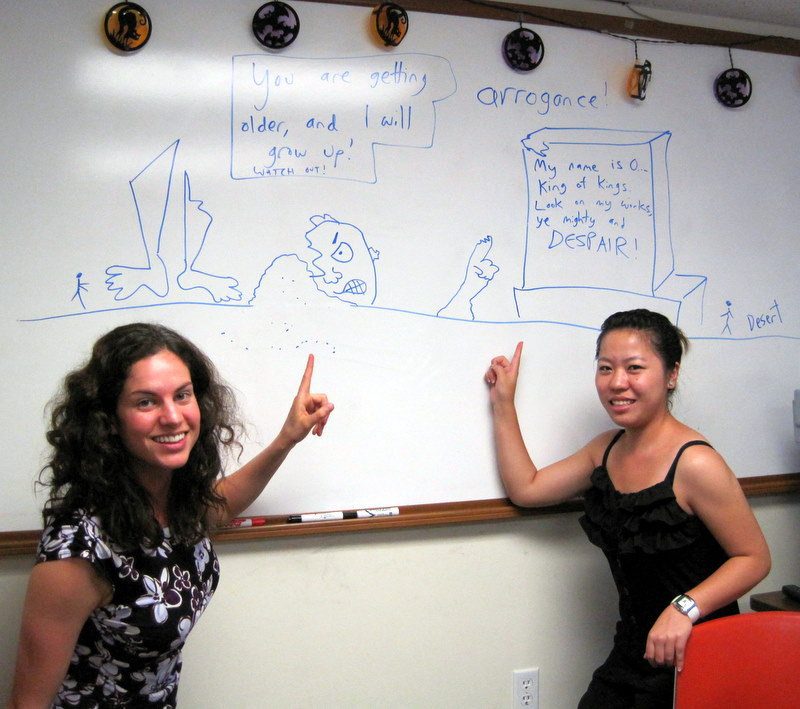
Growth Mindset vs. Fixed Mindset
Assertions that cast our intelligence as fixed and unchanging make us give up on ourselves and others. They're hugely harmful and inaccurate.
So you got a terrible grade in Math? You could just call yourself "dumb" and "not smart at Math" and stop trying... but you know perfectly well that isn't true. You just didn't do the homework, or just didn't reach out to another student or the teacher to figure out a confusing concept.
It's About Metacognition and Finding Strategies that Work
There's no "smart" and no "dumb." There are just strategies that work for you and ones that don't. And if one tactic doesn't boost your success, there are plenty more that will. Bit by bit, with practice and metacognitive reflection, you'll build the skills!
You Can Learn to Travel, Too
How does this apply to traveling? Well, we have these fixed ideas of who we are. We say things like, "I'm someone who could never travel alone," or, "I'm a homebody." Actually, you're not. You've not who you think you are. You are not who people say you are. You are whoever and whatever you want to be, as long as you try, and keep practicing!
You are free to buy a ticket to a place you've never been to and figure out later how you'll plan. You're free to ignore your fear and try something new, out of your comfort zone. And I bet you $5 it will end up excellent!
Back to Being "Bad at Drawing"
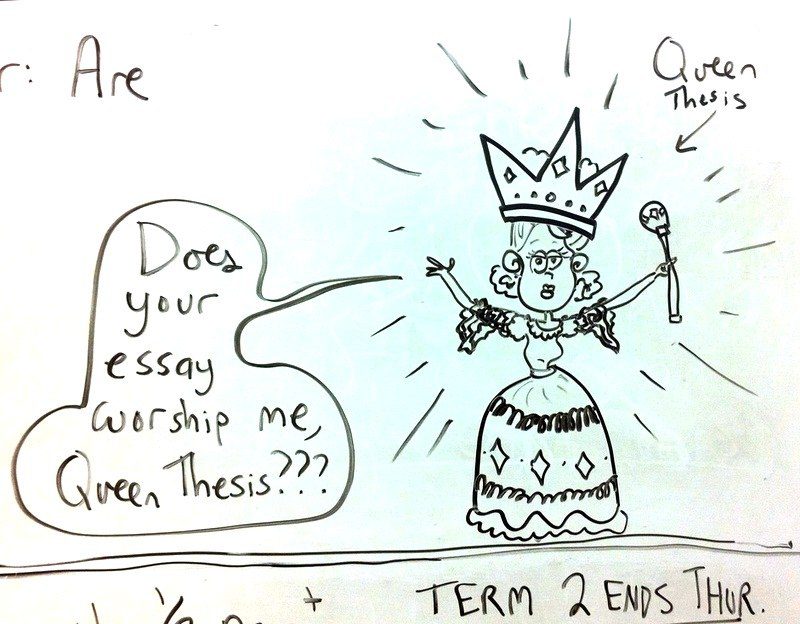
You are not "bad at drawing." You just haven't tried enough! Me, I can bust out vibrant cartoons and lovely sketched faces in about two seconds because I have drawn about 10 people a day for roughly 28 years. Much practice = extra skill, and having skills in creative drawings has proven super useful, in the classroom, for presents, to help others, and for general entertainment.
So I can draw because I've practiced, and I can read and write quite deliciously because I've practiced... and I still can't drive because I have only done it once in nine years! If you call me dumb or smart because of any of these things, it just isn't accurate, because it's all in progress! Want to dive into practice? I've compiled this giant list of 40+ art prompts to get your creativity flowing.
Now what about YOU? How do the labels of "dumb" or "smart" or "bad at ___" or "not a person who ___" show up in your life, and the lives of people around you?

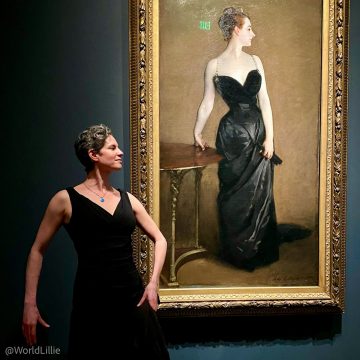
The author, Lillie Marshall, is a 6-foot-tall National Board Certified Teacher of English, fitness fan, and mother of two who has been a public school educator since 2003. She launched Around the World “L” Travel and Life Blog in 2009, and over 4.2 million readers have now visited this site. Lillie also runs TeachingTraveling.com and DrawingsOf.com. Subscribe to her monthly newsletter, and follow @WorldLillie on social media!



What a great attitude, especially for a teacher! Your students are lucky to have someone like you in their corner!
Aw, thanks, Delia! It works in my favor, too. When I have an ineffective teaching day, this principle means that there's hope for improvement in my practice. :)
Wow! This post really hit home for me. I always try to teach my students about growth vs. fixed mindsets when it comes to their learning, but I never really stopped to think about how and why to apply this to my own life. I am going to stop watching all the times I say, "I could never do X" or "I could never afford Y." You are right. You are what you think!
Yay! :)
The pictures are very artistic, but everyone has there own view in art. (: I love drawing.
there is 'drawing' and 'drawing'.everybody can be average at something but to produce a good work one needs to have inteligence for it.the lower iq,the more harder is for somebody to learn new skills doesnt matter if dancing or drawing.and person with low iq is not able to learn at all.scientists says to become artist one needs to have about 120 iq.and secondly- everybody has different inteligence-there is about 5 types (visual,scientific,music,logic..)which is influenced by many factors as genes,or first years after person born,thats why we naturaly inclinate to something different as childs.
u should treat each person individualy but as i see your 'genius productivity' it will not be hard to satisfy you.u r far from average drawer.
There are some people who never study at all and they can get a better grade than someone who spend their time studying. This is probably because they're born smart.
NO! The whole point of this article is that it's about practice and effort, not being "born smart"!
I disagree. I think that there are some things no matter how hard you try, there is no way you will get better at it. For example, I can TRY to understand some elusive concept that has been explained to me breifly, like calculus, and still not understand after hours of trying. However, with some guidance, and application I would most likely get better. Also, there is a difference between applying yourself, and being intellegent. I think grades (especially in the Public School System) are a reflection of your work ethic. Someone can sit in class an entire term and understand everything their teacher is telling them, but if they don't care enough to apply themselves, they aren't going to get a good grade.
Thank you for saying that. I taught piano for many years. There were students who tried very hard but just could not "hear" their wrong notes, or just could not get the notion of rhythm. I am a very good musician, but although I have tried for years to learn to draw or paint, my efforts invariably come out looking worse than a 4-year old's. My brain simply does not see how lines come together to create pictures. And it isn't for lack of trying! Frankly, it's a bit insulting to have someone say that I haven't mastered drawing/painting because I haven't tried. I tend to think that anyone who says that is just lucky enough to be a natural.
Very important point, with a lot of truth to it. The intention was certainly not to be insulting, but when you lay it out like this, I can see how it is. Let's amend it, therefore, to say: We all can get BETTER at something with practice, though some things come more easily to us than others, for a variety of reasons. Thanks for taking the time to comment and deepen our thinking!
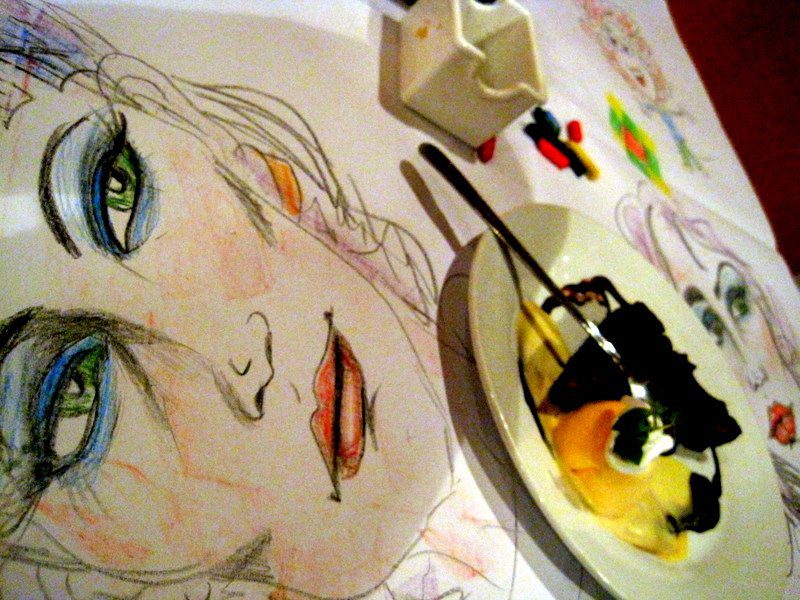
I like the painting at the top a lot. After drawing for about twenty-eight years, don't you ever get a bit frstrated by trying to draw something you can't?
Thanks! It's actually not a painting-- it's a crayon drawing on a paper placemat in Vietnam :) ( The original article is here: https://www.aroundtheworldl.com/2009/10/29/hanois-super-cute-ex-pat-cafes/ ) As for frustration, I'm confident that with enough effort and practice, any of us can draw anything, so no frustration necessary!
I LOVE the painting at the top, it is GORGEOUS! I'd love to be artistically-talented.
Rachel! You missed the point of the entire article: EVERYONE is "born artistically talented"-- you just need to PRACTICE to develop that talent! If you really wish to draw well, start drawing a lot, and maybe even take art lessons. I look forward to your creations!
This is a very interesting article because you said "As a teacher, I firmly believe that people aren’t born smart." Well where do people that are born talented fit in to this statement?
You misunderstood! I mean I don't believe that people are created smart or dumb, I believe anyone can become smart through hard work!
I couldn't agree with you more! Thank you for expressing so eloquently something that I have been saying to people for years! I have taught art and drama, and so many times I have heard my students say that they are "really bad at drawing" or they "can't do improv" etc. I always say to them exactly what you have said!
I believe it is true because I experienced it myself. I remember when I first took an art class. I really wasn't very good at drawing when I first started, understandably. However, I had an excellent art teacher who didn't preach the myth that art skills were this magical 'gift' that some people had and others didn't. Instead, she showed me that learning to draw was all about simply acquiring the hand eye co-ordination skills to record what I was actually seeing, and then practicing those skills over and over again until they became polished and refined. By the end of the year in her class, I was able to create very realistic drawings that I was very proud of. I then went on to study art at university and teach it to children, always making sure that I passed on the same message.
I also like how you applied the idea to travel as well. I have also heard too many people who say they would love to travel but put up barriers for themselves in their minds. People need to realize that their doubting thoughts are really the only thing holding them back!
I like how this article actually taught a lesson. I'm easily discouarged so this article showed me, if I want to get better at something, I'll need to practice. It reminds me of a saying, "Everyone is smart, but some people are just lazier than others." Personally, algebra is not my strongest subject. But when I study and practice, I get good grades :D
I love how you took a picture of the drawing you put on the bored last week. Lol. I agree with you saying that you're not born with the knowledge you have, it grows with practice. But, this goes to say for "drawing, and so it is for schoolwork, sports, interpersonal relations, traveling, cooking, and beyond!' There are certain things that this might not be truthful for, an example is singing. Do you believe that if someone is a terrible at singing, if they practice it might improve? I disagree, at least unless they practice far away from anyone with ears.
I like how you describe there is no dumb or smart thing. I also think that its not they are not smart just they are not trying at their fullest and just too lazy to work for their achievement.
Well, I have bad grades in Algebra because I am allergic to it. When I attempt an equation, my head feels heavy and I pass out. When I wake up, I am on strong medications in a white-walled hospital. I even have to go to the nurse during a Math test! It's a horrid disease called Algebralosis. Please read my story and understand the pain of not being able to learn (and all the work I must make up someday!) Together, we can find a cure. This is me, Josalyn, and my case of Algebralosis. Thank you.
Provocative article – and it totally connects to two recent bestsellers:
1) Outliers by Malcolm Gladwell (he summarizes a theory that you can't become an expert in something without putting in at least 10,000 hours of practice)
2) Mindset by Carol Dweck (her thesis: if you shift seeing intelligence/talent as fixed to seeing it as malleable (which studies show it is), you'll ultimately be much more successful and happy overall)
I definitely agree with your overall argument, but I also think there's a strong counterargument: namely, that people's brains are hardwired in fundamentally different ways. Speaking personally, I have no problem remembering dates, names, numbers, or facts, but I basically have *zero* memory for directions. That doesn't mean that I can't work on improving my sense of direction, but it does put me at a serious disadvantage compared with other people.
I've read & own these books :) sorry I sort of gotten a little excited when I saw this comment in my email
Hmmmm, I don't know. I believe there's a difference between actual smart people and those who just do their work. Let's say dancing, a person who has never danced in their entire lifetime can begin and spend 24/7 in a dance studio but there would always be that one person who was born with the gift to dance; the ability to move their body ever so gracefully across a stage effortlessly. I believe everyone is born with that one special talent, some of us just haven't quite found it yet. Now let us apply this idea to academics, to say that a person can be smart or is smart simply because they complete their work isn't fair to those who are smart naturally and with that being their only talent. Also, when you come to think of it all of the skills discussed like driving or drawing require smaller skills that (possibly) our brains and bodies are inclined to accomplish better than others automatically. The same idea can be applied for those who can sing.
You know, after reading what you posted I sort of changed my view on the what ideas of dumb and smart are. I do believe that if you work at something you can achieve it. An example would be me learning the butterfly stroke. It took me a while and at first I thought I wasn't physically able to do it but with hard work, determination , and motivation I was able to do it.
I can draw very good and my math grade grade is a A- but I cannot drive very good either Ms. Marshall.
Hi Ms. Marshall! This is my favorite article, because it really opened my mind into changing how I talk like. I would always say "I can't do it" when it comes to school and swimming. This article has made me understand why I might not be the best at something- it's because I haven't tried enough in it. I also like how it's mainly about drawings and people who say "I can't draw for my life!", because I also hate when my friends look at my drawings and tells me that they're jealous of how good I draw. Anyways, thanks for writing this article. It really helped me a lot!
You speak the truth. Great post Lillie.
Thanks, Phil. Oh my gosh-- I just realized that you, Phil, are the embodiment of everything this article stands for! Readers, Phil is a U.S. teacher who decided to take off to travel the world (chiefly Africa)... and teach the world how to DRAW CAMELS! And he wrote a book about it which is totally hilarious. Pop over here to see it: http://philintheblank.net/2010/12/07/how-to-draw-camels-ebook/ :)
You can also read a profile of Phil on our sister site, here: http://www.teachingtraveling.com/2010/10/27/interview-with-phil-from-a-dc-charter-school-to-africa/ .